Field-hospital status of the Ruthven mansion
Young Captain Jack · The Son of a SoldierThe field-hospital status of the Ruthven mansion is one of the clearest ways the American Civil War enters domestic life in Oldville. What begins as a private home becomes a working medical refuge when six wounded Confederates are brought inside, their care organized by Mrs. Ruthven and Marion under the direction of a young surgeon. The hospital does not remove the plantation from the war: it places the household directly in the path of retreating armies, guerrillas, theft, coercion, and renewed fighting. Its protection depends partly on the moral force of the hospital itself and partly on the courage of Jack Ruthven and the people around him.
Formation and Wartime Setting
The mansion’s conversion occurs during a week of mounting danger for Oldville. The army of the North has driven the army of the South steadily backward until Confederate troops are encamped less than four miles from Jack Ruthven’s home. Cannon fire can be heard for two days, while the women of the district fear that Northern troops will descend upon their homes and pillage them. The house therefore stands in a landscape where the distinction between civilian residence and military position is becoming unstable.
The surrounding community is also being reorganized by war. Trade in Oldville has nearly collapsed: when Marion Ruthven goes to Lemuel Blackwood’s general store, its stock is scanty and shop-worn, and the town’s ordinary commercial life has been damaged by the conflict. Later, when Mrs. Ruthven and Marion go into town for necessary trading, they find the stores closed and the tavern crowded with men who have recently joined the Confederate ranks. The plantation hospital belongs to this same wartime transformation, in which household space, commerce, transport, and local defense are all pressed into emergency service.
Operation as a Hospital
The hospital is established through an immediate act of hospitality under pressure. Several Confederates cross the lawn carrying stretchers and announce that they can take the wounded no farther. Mrs. Ruthven agrees at once to receive them and summons the servants to prepare cots on the lower floor, since carrying badly injured men upstairs would be impractical. The arrangement is both compassionate and logistical: the sitting room becomes a treatment ward, the servants become part of the emergency response, and the domestic architecture is adapted to battlefield medicine.
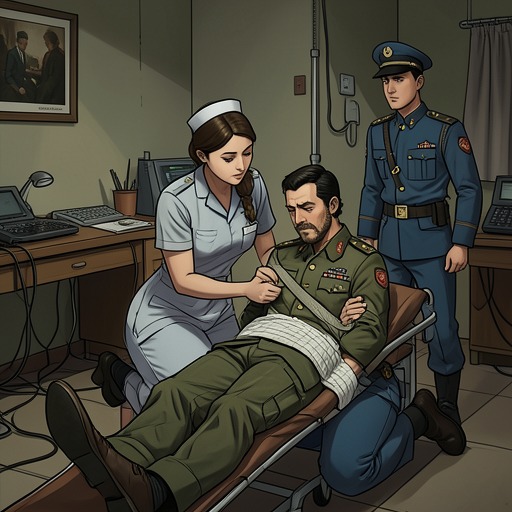
The number of patients soon reaches six. A young surgeon begins work without delay, while Mrs. Ruthven and Marion assist him. Their participation gives the hospital a distinctly household character, but it is not merely symbolic charity. The women help sustain a functioning medical space while armies pass the plantation. Confederates move along the road on foot and horseback, exhausted, ragged, dusty, dirty, and often wounded; small-arms fire stops, distant cannon continues to boom, and shells occasionally burst nearby. The hospital consequently operates amid noise, retreat, and continuing danger rather than in a secure rear area.
The hospital’s status is marked materially by its flag. During a later attack, after George Walden is found senseless beneath wreckage with blood flowing from a wound in his temple, he is carried to another part of the house and laid on a fresh cot while Marion cares for him. At the same time, Old Ben is instructed to raise the hospital flag higher on the mansion. The gesture makes the building’s medical identity more visible at precisely the moment when its occupants most need protection. The flag is not decoration; it is an appeal to combatants to recognize the house as a place of treatment rather than a legitimate object of seizure.
Protection Against Armies and Guerrillas
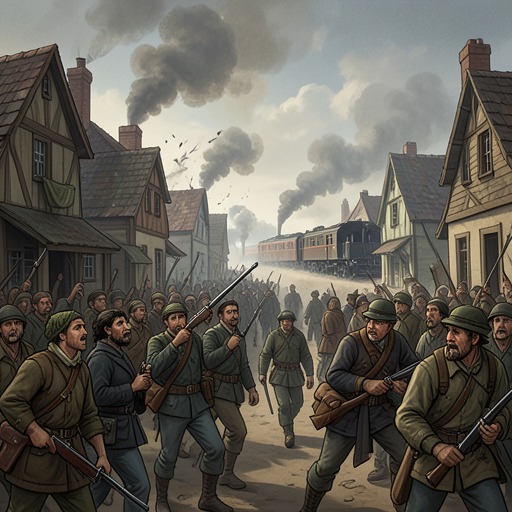
The hospital’s greatest test comes when a company of guerrillas follows the passing cavalry. The narrator distinguishes these men from regular soldiers by describing them as followers of every army who fight chiefly to loot afterward. Their captain, Sandy Barnes, orders his company toward the house, and Jack Ruthven responds by drawing his nineteen Home Guard boys across the lawn. Each boy has a loaded gun or pistol, and the improvised line gives the plantation a visible defensive force.
Jack does not present the mansion merely as property belonging to his family. He states that it is private property and, more importantly, that it is now a hospital containing six wounded Confederates under the care of a surgeon. The appeal joins property rights to medical neutrality: the guerrillas are asked to respect both the household and the vulnerable men inside it. When someone in the rear ranks urges the company to proceed because the house looks worth visiting, the threat becomes unmistakably predatory. The hospital designation is thus tested against greed rather than against ordinary military necessity.
The defense also reveals a local ethic of protection. Old Ben quietly displays a long, old-fashioned pistol and declares that anyone trying to shoot Jack Ruthven will have to answer to him. Jack thanks him and promises that he will not forget Old Ben if he grows up and becomes rich. The exchange places loyalty across the household’s social hierarchy at the center of the hospital’s defense: the medical refuge survives not only through formal military rules but through personal bonds, local courage, and readiness to resist theft.
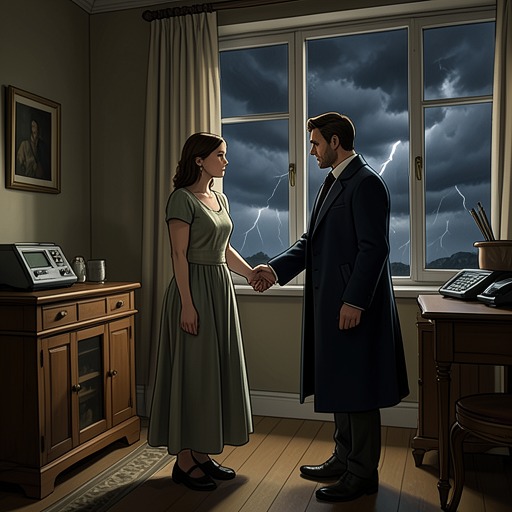
Regular military authority provides a sharp contrast with the guerrillas. When a Confederate colonel arrives, Jack anxiously asks that nothing be done to the place because it is private property and shelters six wounded men. The colonel answers that an officer who is a gentleman respects private property and that, so long as the household does nothing treacherous, neither he nor his men will harm it. Later, when Mrs. Ruthven asks whether the family should regard itself as prisoners of war, the colonel rejects that status and orders that the house remain a hospital. The mansion is therefore treated as a protected medical site rather than as an enemy position, and the colonel’s conduct establishes military honor as a practical restraint on violence.
Limits and Contradictions of Protection
The protection offered by the hospital is real but fragile. The household remains surrounded by armed men, and the mansion’s medical function does not prevent violence from reaching its rooms. During renewed fighting, George Walden is wounded by falling wreckage and must be added to the patients. After the last shot in the vicinity, the armies withdraw toward the mountains, but the hospital has endured the battle rather than escaped it.
The plantation’s horses are also threatened. When Jack goes toward the stable and barns, he finds Old Ben and two Home Guard boys fighting three guerrillas who are trying to steal several horses. Old Ben insists that the animals are private property, but the guerrillas answer with contempt and claim that they will take them. This scene shows how unevenly wartime protections are applied. A regular officer can recognize private property and hospital status, while irregular raiders treat the same space as an opportunity for plunder. The mansion’s safety therefore depends on identifying which armed group controls the immediate scene and whether its members accept any common rule.
The hospital’s vulnerability is intensified by the conduct of Dr. Mackey. Although associated with medicine, he does not represent the humanitarian purpose embodied by the mansion’s young surgeon, Mrs. Ruthven, and Marion. After Jack calls him a fraud, Dr. Mackey threatens to make him suffer, seizes him by both arms, and orders Confederate soldiers to conduct him to camp and prevent his escape. The contrast is stark: the mansion uses medical space to preserve wounded lives, while Dr. Mackey exploits medical and military authority to impose captivity. The text therefore refuses to treat the word “doctor” as a guarantee of ethical conduct.
Meaning and Narrative Function
The mansion hospital creates a temporary zone in which ordinary domestic boundaries are redefined by humanitarian obligation. A sitting room becomes a ward; women of the household become caregivers; servants prepare cots; a wounded soldier such as George Walden is received alongside the original patients; and a flag announces that the building should be treated differently from a military target. The transformation shows how wartime service can arise from a private household without erasing the household’s own claims to safety and property.
At the same time, the hospital exposes the difference between rules and the people who enforce them. Jack repeatedly invokes private property and the presence of wounded men; the regular Confederate colonel recognizes those claims, while Sandy Barnes’s guerrillas seek to violate them. The resulting contrast gives the hospital status an ethical dimension. Protection is not simply a technical privilege conferred by a flag. It is a test of whether armed men can distinguish civilians, patients, and caregivers from combatants and booty.
The mansion also becomes a place where the novel’s larger conflicts converge. War brings wounded bodies into the home, while questions of family identity and authority are argued around it. Dr. Mackey’s claim that he is Jack Ruthven’s father and his later attempt to have Jack taken to camp show how medical, legal, and military language can be used to control a person. The account of Colonel Stanton’s brutal treatment by a physician named Mackenzie, later identified as Mackwell or Mackey, deepens the suspicion surrounding medical authority. Against these coercive uses of expertise, the field hospital represents care grounded in action: receiving the helpless, treating injuries, protecting patients, and preserving a human boundary in the middle of war.